PRIVATE TECHNOLOGY BRIEF
FOR THOMSON REUTERS
INTELDAS DEVELOPS
FORENSIC INJURY EVIDENCE →
THE ORIGINAL MEDICAL
RECORD NEVER DID.

YOU'RE MOVING CoCOUNSEL
CLOSER TO THE EVIDENCE.

WHAT IF THERE'S MORE
EVIDENCE TO GIVE IT?

Claim Intelligence & Pipeline Visualization
Interactive Evidence Room

INTELDAS™ EVIDENCE ROOM

See the capability. Examine the outputs. Test the difference.

1. THE PROBLEM

AI has a medical-record problem.

It can't reason from evidence it never received.

Legal AI has become extraordinarily capable at searching, organizing, analyzing, reasoning from and drafting with existing information.

But there is an upstream limitation:

What happens when consequential medical evidence was never developed in the original record?

2. THE CAPABILITY

From evidence retrieval to evidence development.

FEDI™, the proprietary, patent-pending Forensic Evidence Development Intelligence engine within INTELDAS™, is designed to identify consequential medical evidence that should be investigated, quantified or developed beyond what appears in the original record.

INTELDAS then carries that developed intelligence forward into attorney-facing forensic work product.

The distinction is simple:

Traditional AI: What does the record contain?

INTELDAS: What consequential evidence should be investigated that the record does not adequately contain?

3. THE COMMAND CENTER

Don't read our claim. Examine the difference.

ORIGINAL MEDICAL RECORD
↓
INTELDAS™ FORENSIC ANALYSIS
↓
NEWLY DEVELOPED MEDICAL-FORENSIC INTELLIGENCE
Inteldas Actual-Case Command Center with Five Evidence Categories

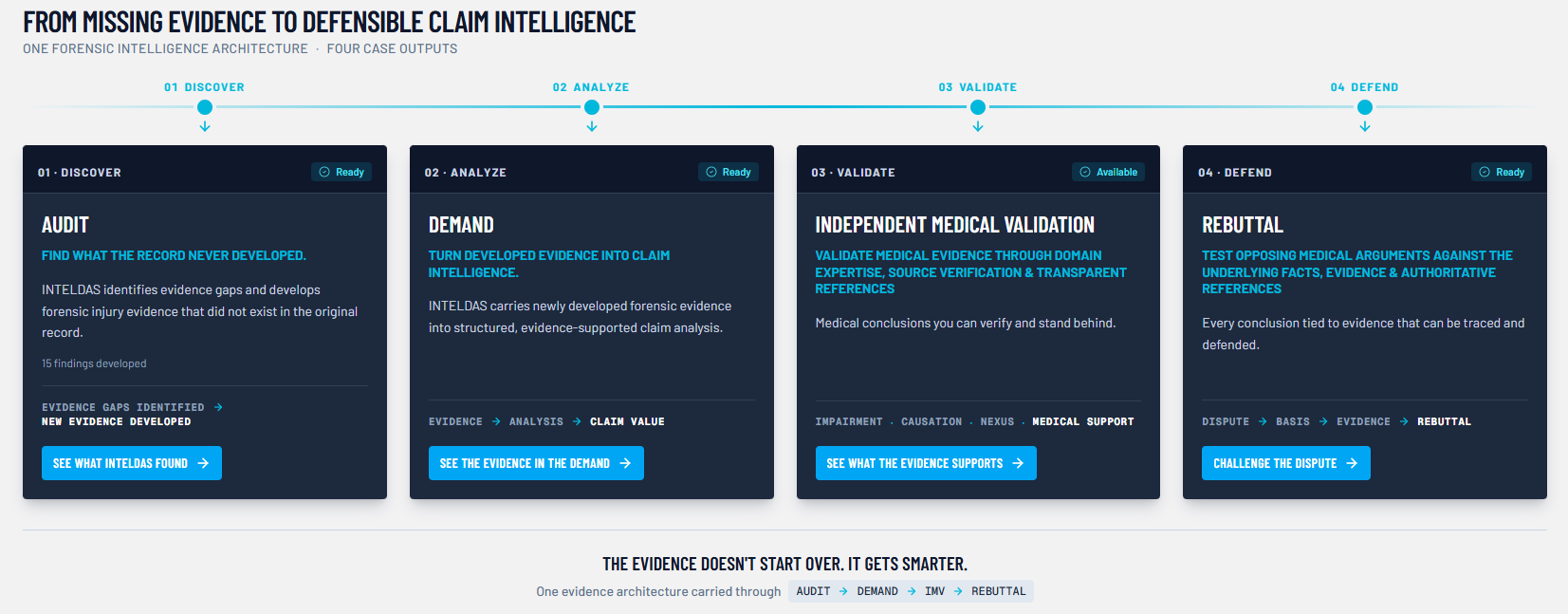
4. ONE EVIDENCE ARCHITECTURE. FOUR FORENSIC WORK PRODUCTS.

AUDIT → DEMAND → IMV → REBUTTAL
DEVELOP IT • PRESENT IT • VALIDATE IT • DEFEND IT

The evidence doesn't start over with each report.

The underlying intelligence carries forward through the claim.

And there is an important distinction:

THE AUDIT CAN STAND ALONE.

Thomson Reuters does not have to replace its demand workflow—or use the INTELDAS Demand at all—to test the evidence-development capability.

The INTELDAS Forensic Evidence Audit can operate independently as the medical-evidence layer.

Or the same developed intelligence can continue through the complete INTELDAS architecture.

Keep the demand. Keep the workflow. ADD THE EVIDENCE.

THE COMPLETE REPORTS ARE AVAILABLE BELOW FOR REVIEW.

Click any box below to launch the interactive flipbook viewer preview instantly.

Actual INTELDAS™ Work Product
AUDIT
Develops the medical-forensic evidence the original record did not adequately contain.
Can stand alone as an independent evidence-development report or feed the complete INTELDAS architecture.
Actual INTELDAS™ Work Product
DEMAND
Carries the developed evidence into the attorney's claim presentation.
Integrates the medical, functional, impairment and economic evidence into an attorney-facing forensic demand.
Actual INTELDAS™ Work Product
IMV — INDEPENDENT MEDICAL VALIDATION
Tests and validates the medical foundation of the claim.
Provides an independent medical analysis of the diagnoses, causation, impairment, functional consequences and supporting evidence.
Actual INTELDAS™ Work Product
REBUTTAL
Defends the evidence when the claim is challenged.
Addresses opposing medical opinions, disputed findings and conflicting interpretations using the developed medical-forensic evidence.

5. THE CASE PROOF

See what changes when the missing evidence is developed.
See the Missing Layer
▶
See the Missing Layer
Why evidence development belongs upstream of legal AI.
Take the One-Case Challenge
▶
Take the One-Case Challenge
See the original evidence. See what INTELDAS developed. Then decide.
Witness the forensic transformation:
✓
See the original medical evidence.
✓
See what INTELDAS developed that wasn't adequately there before.
✓
See the difference for yourself.
"The question isn't whether AI can do more with the evidence. It's what AI could do with evidence it never had."

WHY THIS CAME FROM THE MEDICAL SIDE

INTELDAS™ did not begin by teaching AI to write a better demand.

It began with a medical-evidence problem.

For more than four decades, Dr. Frank Liberti's work has operated at the intersection of clinical injury evaluation, medical evidence and personal-injury litigation.

More than three decades ago, that work included serving as a medical expert in New Jersey Supreme Court litigation addressing the objective medical evidence necessary to establish qualifying injury under the state's tort threshold—the Verbal Threshold—where the injury claim required proof of significant, consequential and permanent injury.

The lesson was consequential:

The injury alone wasn't enough. The medical evidence had to demonstrate its significance and consequences.

That same problem now exists in a different technological environment.

Today's legal AI can perform extraordinary work with the information it receives.

But AI still cannot reason from consequential medical evidence that was never developed into the case.

INTELDAS grew from more than 13 years of engineering medical-legal forensic methodologies and clinical decision intelligence around that problem.

The result is not simply another demand generator.

It was built to solve the medical-evidence problem before the demand is written.

AN INVENTOR'S PERSONAL NOTE

For years, I kept asking myself a simple question: Why hadn't the legal-AI and demand-formulation companies already solved this?

I believe part of the answer is that we approached the same claim from opposite directions.

Most legal AI naturally begins with the record it receives:
RECORD
↓
SEARCH
↓
ANALYSIS
↓
LEGAL WORK PRODUCT
I came to the problem from the medical side:
INJURY
↓
MEDICAL EVIDENCE
↓
CONSEQUENCE
↓
CLAIM

That difference matters.

If you begin with the existing record, the natural question is:

“What can AI find, analyze and produce from this evidence?”

My question was different:

“What consequential medical evidence should exist to properly demonstrate this injury—but was never developed in the first place?”

That question ultimately led to INTELDAS™ and FEDI™.

Not simply another way to analyze the evidence.

A proprietary, patent-pending system designed to develop supportable medical-forensic intelligence that wasn't adequately present in the original record.

Perhaps that's why the missing-evidence gap was easier for me to see from the medical side.

I wasn't trying to teach AI to write a better demand.

I was trying to make sure the demand had better evidence to work with.

— Dr. Frank Liberti
Inventor & Founder, INTELDAS™
WHY THIS MATTERS TO THOMSON REUTERS

Comparing the standard platform trajectory versus an evidence-first integration architecture.
TODAY Standard Pipeline
01
MEDICAL RECORD
↓
02
SUPIO — ANALYZES CASE INFORMATION
↓
03
WESTLAW — VALIDATES AGAINST AUTHORITY
↓
04
CoCOUNSEL — REASONS, RESEARCHES AND DRAFTS
NOW ADD THE EVIDENCE-DEVELOPMENT LAYER Upstream Integration
01
MEDICAL RECORD
↓
✦
FEDI™ — INVESTIGATES AND DEVELOPS MISSING MEDICAL-FORENSIC INTELLIGENCE
↓
02
SUPIO
↓
03
WESTLAW
↓
04
CoCOUNSEL

INTELDAS doesn't ask Thomson Reuters to replace the workflow it is building. It asks what that workflow could do with evidence it never had before.

THE ECONOMIC QUESTION

If developing previously unavailable medical evidence can:

  • Reduce attorney reconstruction time,
  • Reduce dependence on separate outside forensic work,
  • Improve the evidentiary foundation for disputed or undervalued claims,
  • And make downstream AI more useful,

then the value isn't another document.

It's what changes upstream of every document that follows.

And now the proposition becomes even easier to test because the Audit can stand alone.

Thomson Reuters doesn't have to decide whether it wants another demand solution.

It only has to answer one question:

DOES THE EVIDENCE CHANGE?

DON'T TAKE OUR WORD FOR IT. TEST IT.

Take one personal-injury case your team already knows.

Use the same original medical record.

Your existing process does what it does.

INTELDAS does what it does.

Then put the resulting evidence side by side.

If we're wrong, you'll know it.

But if we're right, we should have a very different conversation.

Dr. Frank Liberti
Inventor & Founder, INTELDAS™
727-520-3961
f_liberti@msn.com
"The question isn't whether AI can do more with the evidence. It's what AI could do with evidence it never had."
MISSING RECORDS CAN BE FOUND.
MISSING EVIDENCE HAS TO BE DEVELOPED.
THAT'S WHERE INTELDAS BEGINS.